

You take your ready-2 supplement, brush your teeth, crawl into bed, and close your eyes. Eight hours later, you wake up again. What happened in the meantime? Absolutely nothing, right? Just some sort of standby mode until your alarm mercilessly goes off.
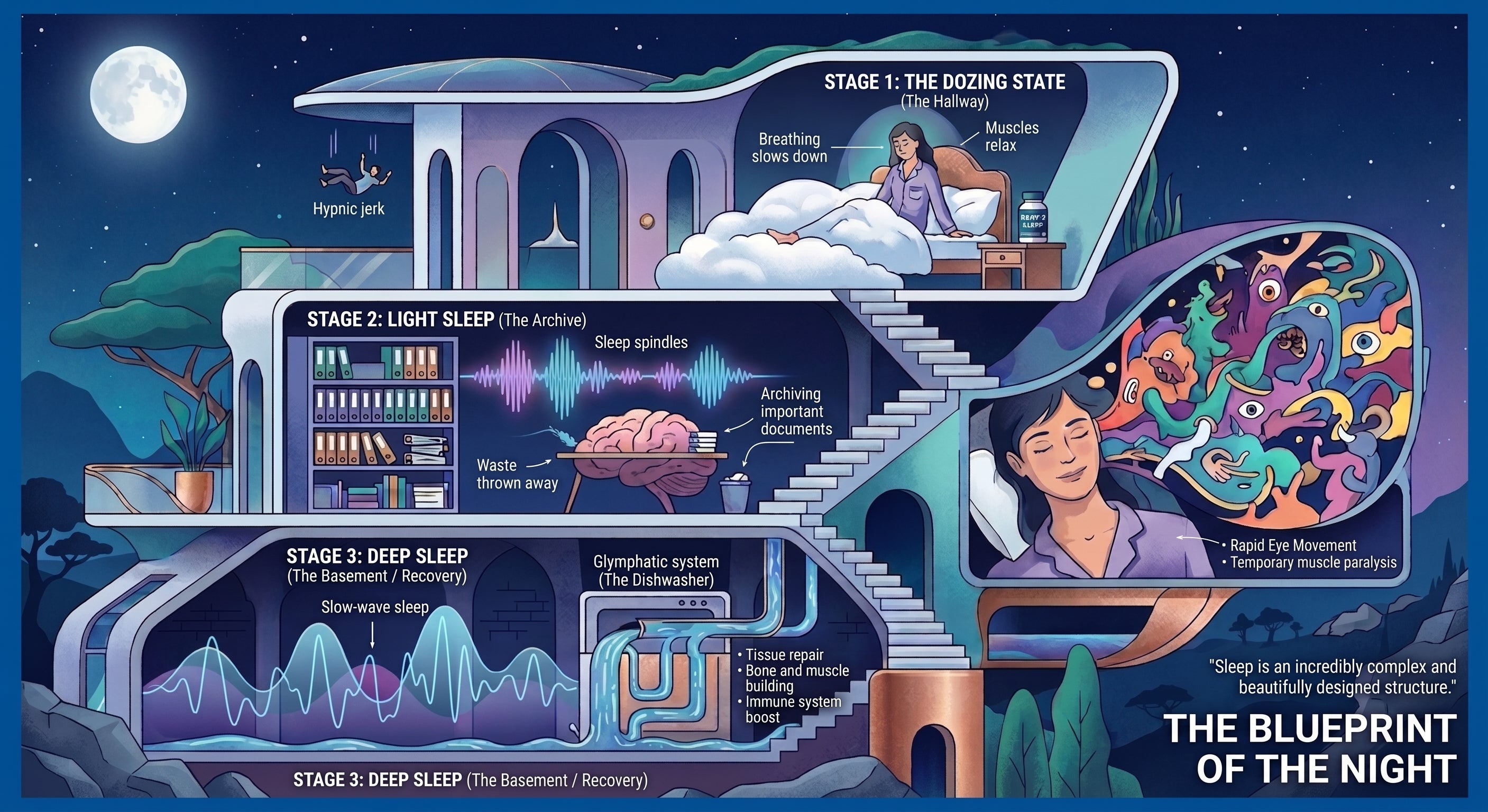
Unfortunately (or actually, fortunately), we can tell you that this is incorrect. Your brain is at least as active at night as it is during the day. It is not a simple off-switch you press. Sleep is an incredibly complex and beautifully designed structure. That is why in the medical world, we speak of 'sleep architecture'. And just like a real building, the whole thing collapses if the foundation is flawed. Let's take a walk through your nocturnal palace and see what exactly is going on while you are out cold.
You do not sleep in one long, flat line. Your night is divided into cycles of about 90 to 110 minutes. During a good night, you go through about four to five of these cycles. Each cycle consists of different stages, roughly divided into non-REM sleep and REM sleep. Within that non-REM sleep, we slowly descend a staircase of three steps.
This is the hallway of your sleep building. You just got into bed, your breathing slows down, and your muscles begin to relax. Sometimes they relax a bit too abruptly, causing that familiar twitch where it feels like you are falling into an abyss. Medically, we call this a hypnic jerk, but it is really just your brain panicking for a second because your muscles are surrendering to gravity.
This stage only lasts a few minutes. If your partner wakes you up right now because you started snoring softly, you will probably indignantly claim you were not sleeping at all. You were just resting your eyes.
We walk further into the building. Your core body temperature drops a little, and your heart rate calms down. Your brainwaves slow down, but occasionally there are sudden bursts of activity. We call these bursts sleep spindles. This is the moment your brain starts filing.
Imagine your brain as a messy desk after a long workday. During stage 2, the useless receipts are thrown away, and the important documents are neatly organized into folders. You spend about half of your entire night in this stage. It is a crucial part of the transition to the true recovery phase.
Now we have arrived in the basement of the sleep architecture, also known as slow-wave sleep. This is the holy grail of physical recovery. Your brainwaves are now extremely slow and large. Try waking someone up during this stage. They will look at you as if you came from another planet and have no idea what day it is.
In this deep sleep, the real magic happens for your body. Your tissues are repaired, your bones and muscles are rebuilt, and your immune system gets a significant boost. Furthermore, the so-called glymphatic system opens up. This is literally the dishwasher of your brain. Cerebrospinal fluid rapidly washes away the waste products that have accumulated during the day. Sounds like a stage you do not want to miss, right?
A tip from the doctor: Deep sleep is highly dependent on how long you have been awake (your sleep pressure). If you move a lot during the day and do not drink too much caffeine in the afternoon, you build up enough pressure to drop like a brick into stage 3 at night.
After deep sleep, we climb back up the stairs, but we do not wake up. We step into REM sleep (Rapid Eye Movement). This is by far the most bizarre room in the house. Your breathing becomes irregular, your heart rate rises, and your eyes dart rapidly back and forth beneath your closed eyelids.
If we were to measure your brain activity right now, the scan would look almost identical to when you are wide awake. This is the stage where you dream. To prevent you from actually performing that karate kick from your dream on the person lying next to you, your brain temporarily paralyzes all the muscles in your body. A brilliant feat of self-protection.
While deep sleep is all about physical recovery, REM sleep is the psychologist of the night. It helps you process emotions and make creative connections. Things you learned during the day are now firmly anchored in your long-term memory.
What many people do not know is that not every sleep cycle is the same. During a normal night, your initial cycles are packed with deep sleep (stage 3), with very little REM sleep. As morning approaches, your biological clock takes control, and this ratio shifts. Deep sleep fades almost entirely into the background, and the REM stages become increasingly longer.
This explains why, after pulling an all-nighter and only getting into bed at three in the morning, you feel like you were hit by a truck the next day. It is not that you missed a fixed time slot for deep sleep. In fact, because you have been awake for so long, your accumulated sleep pressure is immense, and your brain immediately and desperately dives into the basement of deep sleep. The problem is that your biological clock ignores this completely. In the early morning hours, it relentlessly starts fueling the dream factory (REM sleep) and the awakening process once again. As a result, your extreme need for physical recovery clashes head-on with your natural day-night rhythm. The outcome is a fragmented, compressed night, meaning you do not go through that beautiful, aligned blueprint necessary to fully repair everything.
Sleep is not a passive activity; it is elite sports for your cells. It is a delicate process that requires rest, regularity, and the right building blocks. And that is exactly why we at Ready² focus on relaxation before bedtime. If you dive into bed stressed, with a busy mind and a high heart rate, you do not give your brain the chance to smoothly navigate from the hallway (stage 1) to the basement (stage 3). You get stuck in shallow micro-naps.
So the next time you get ready for the night, just consider what a complex and beautiful system you are about to boot up. Give your body the time to wind down, trust the architecture of your brain, and sleep well.
The Ready² sleep supplement is designed to support all these stages. The goal is to fall asleep faster, sleep deeper, sleep longer, and wake up well-rested. No nonsense; just an honest supplement with high dosages.
Share:
Behind the decks with Good Life Agency